
AI in MintHCM
AI in MintHCM: what works today and where it is going
MintHCM is an open source HR system that AI assistants can already work with: its MCP server lets an assistant search, read and update HR data under a user’s permissions.
That makes MintHCM AI-enabled today. The direction is AI-native: a system built so that agents are first-class clients next to people. This page maps what exists now, what is still early stage and where each topic is explained.
In short
MintHCM works with AI in three ways: an MCP server that exposes HR data to assistants (available today), agents configured as records inside the system (early stage, not released) and an agentic process that builds MintHCM itself. Everything is open source, so each claim can be checked in the code.
On this page
- What does AI in MintHCM cover?
- What is the difference between AI-enabled and AI-native software?
- Where does AI work in MintHCM today?
- Why does headless architecture matter for AI in HR?
- How is MintHCM itself built with AI agents?
- Why does open source matter for AI in an HR system?
- What does MintHCM not do yet?
- How can you start with AI in MintHCM?
- Frequently asked questions
What does AI in MintHCM cover?
AI in MintHCM covers six topics: an AI Agent, the Mint MCP server, an open source approach to AI, compliance with the EU AI Act, agentic engineering and headless architecture. Each has its own page. This page gives the short version of each and says which parts you can use today.
AI Agent
A chatbot for HR tasks, available as an open source proof of concept.
Mint MCP
The server that lets assistants work with MintHCM data.
AI + open source
Why MintHCM is built in the open.
AI Act
What the EU regulation means for HR software.
Agentic Engineering
How AI agents build MintHCM under human control.
Headless HCM
Why the interface is no longer the only way to use an HR system.
What is the difference between AI-enabled and AI-native software?
An AI-enabled system adds AI features and integrations to a product designed around its screens. An AI-native system is designed so that AI agents are first-class users: a complete API, permissions enforced in the data layer, documented processes and a data model a model can read. MintHCM is AI-enabled today, and its adopted strategy is to become AI-native step by step.
| AI-enabled (MintHCM today) | AI-native (MintHCM direction) | |
|---|---|---|
| Main way to use the system | The screen, with an MCP server as a second channel | The API, with the screen as one client |
| Permissions | Assistants work under the signed-in account’s permissions | Enforced in the data layer for every client |
| Data model | Being cleaned up: field names, dropdowns, relationships | Named and documented so a model understands it |
| Where agents run | Outside, in your assistant | Inside, as configured records |
Where does AI work in MintHCM today?
The only layer you can deploy today is the MCP server. It is part of the MintHCM core since version 4.2.0, and OAuth for remote connectors is available from 4.3.3. The AI Agent and the AI Agents module are earlier on the road. The cards show the status of each element so you can plan around what exists.
MCP server
What it does
Search, count and read records, run existing reports. Create, update and delete only after your confirmation.
Where it runs
On your own MintHCM instance.
Available
AI Agent (chatbot)
What it does
Natural-language chat for HR tasks, built on LangGraph, works with OpenAI, Claude and Gemini.
Where it runs
Separate application with its own backend.
Proof of concept
AI Agents module
What it does
Agents defined as records, triggered by a record save or status change.
Where it runs
Inside MintHCM.
Early stage, not released
AI Act guidance
What it does
Explains obligations for recruitment and employee-evaluation software.
Where to read
The AI Act page and two articles.
Published
Privacy: requests go directly from the assistant to your instance. They do not pass through eVolpe or MintHCM servers.
Why does headless architecture matter for AI in HR?
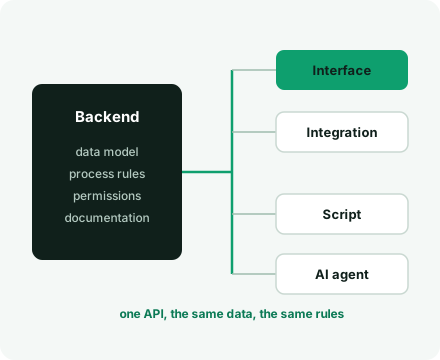
An AI agent never uses the screen, so any rule enforced only on the screen stops working when the first agent connects. Headless HCM keeps data, process logic and permissions behind an API and treats the interface as one client.
MintHCM exposes its modules through an API and an MCP server. The other headless layers are at an early stage of work.
Permissions enforced only on the screen stop working when the first agent connects. Read the full explanation in Headless HCM.
How is MintHCM itself built with AI agents?
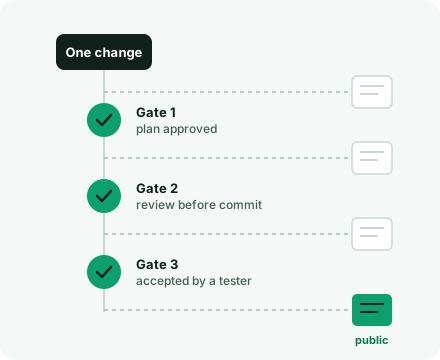
MintHCM is developed with AI agents under a fixed process with three human gates: plan approval, review before commit and acceptance testing. The team uses Claude Code with its own implementation instructions.
Every change leaves four artefacts: a plan, a verification report, a code review report and a public release-notes entry. MintHCM has more than fifty connected modules, which is why the gates exist.
3
human gates per change
Agentic Engineering page
4
artefacts left by every change
Agentic Engineering page
50+
connected modules to protect
Agentic Engineering page
See the process and how to check it: Agentic Engineering.
Why does open source matter for AI in an HR system?
MintHCM is open source under AGPL-3.0 and self-hosted, so you can read the code that handles your HR data and choose which model or assistant you connect. Under the EU AI Act the organisation deploying a system carries the obligations, so being able to inspect and audit the software helps. Recruitment and employee-evaluation systems are classified as high-risk AI (Regulation EU 2024/1689).
You read the code
Every claim on this page can be checked in the repository and the changelog.
You choose the assistant
Any MCP client can connect. The AI Agent proof of concept works with OpenAI, Claude and Gemini.
You keep the data
The system runs on your instance. Under the AI Act the organisation using the system carries the obligations.
Read more: AI Act and AI + open source.
What does MintHCM not do yet?
These limits are worth knowing before you decide.
AI Agent chatbot
A proof of concept. It runs as a separate application, needs its own backend and may give inconsistent answers.
AI Agents module
At an early stage and not released publicly.
AG-UI
On hold, with no code. A built-in chat that would drive the application.
Web MCP
A proof of concept outside MintHCM. Markup that would help browser agents read public pages.
The data model is still being tidied. An agent is only as good as the description of the data it receives.
How can you start with AI in MintHCM?
The most reliable test is your own data. Install MintHCM or open the demo, connect an assistant through the MCP server and check whether asking questions in plain language shortens your work.
- Get MintHCM: try the demo, start in MintHCM Cloud or download it from GitHub
- Update to version 4.3.3 or later and enable the MCP tools for the relevant role
- Connect your assistant: the wiki describes Claude, the MCP setup guide describes Visual Studio Code with Copilot Chat
- Ask a real question, for example which candidates are waiting at the entry interview stage.
Frequently asked questions
Does MintHCM have built-in AI?
Today the MCP server, part of the core since version 4.2.0, lets an external assistant work with MintHCM data. The AI Agents module and an in-system chat are at an early stage and have not been released.
What is the MintHCM MCP server?
Model Context Protocol is a standard that lets an AI assistant discover and use tools. The MintHCM server exposes modules through it, so an assistant can search, count and read records, run reports and, with your approval, change data.
Can an AI assistant see data a user cannot?
No. The assistant works under the permissions of the MintHCM account you sign in with and reaches only records that account can open.
Does my HR data go to eVolpe or MintHCM servers when I use an assistant?
No. The assistant connects directly to your instance. Records it reads become part of your conversation and are handled under the terms of your assistant’s plan.
Which assistants and models work with MintHCM?
Any client that supports MCP. The wiki documents Claude, and the setup guide covers Visual Studio Code with Copilot Chat. The AI Agent proof of concept works with OpenAI, Claude and Gemini models.
What does AI-native mean for MintHCM?
A system designed for agents as well as people: full API, permissions in the data layer, a readable data model. It is the adopted direction, and the MCP server is the first working layer.
You do not have to take our word for it
Every statement on this page can be checked in the repository, the changelog and the documentation. Open the code, connect an assistant and see what works on your own data.