


22 Jun How Claude and MintHCM Make Everyday Recruitment Work Easier
Key Takeaways
- Recruiters lose up to 14 hours per week on tasks AI could handle (Ashby Talent Trends Report, 2024) – data entry, interview scheduling, status updates, pulling together data from multiple modules..
- MCP (Model Context Protocol) is the layer that connects an AI assistant directly to an HR system – Claude doesn’t just answer questions; it acts inside MintHCM: searching records, creating candidatures, querying data across modules simultaneously.
- MintHCM is among the first HCM systems with MCP built into the product itself – not a wrapper built by a third party around an API, but a native component maintained by the same team as the rest of the software.
- Recruiters no longer need to log into the system to get data – a natural-language question to Claude is enough; the answer comes from live MintHCM data.
- The impact is visible across the entire recruitment funnel – from candidature intake, through Entry Interview analysis and salary range verification, to launching onboarding immediately after hire.
Why Do Recruiters Lose So Much Time on Administrative Tasks?
A typical recruitment process involves dozens of tasks that must be completed correctly and on time: candidates move through stages each requiring a status update, meetings need to be scheduled, notes written up, data assembled. Each task takes a few minutes. Across a week, those minutes turn into hours.
Industry data confirms the scale of the problem. According to the Ashby Talent Trends Report (2024), as cited by recruitaisuite.com, 45% of talent acquisition leaders spend more than half their working time on administrative tasks that could be automated through AI – dominated by screening, scheduling, and data entry. Interview scheduling alone accounts for 35% of a recruiter’s time, making it the single biggest time drain in the entire process.
The workload is also increasing: according to the Gem 2025 Recruiting Benchmarks Report, recruiters today manage 56% more open positions and 2.7 times more applications than three years ago, while team sizes have stayed flat or shrunk.
An HCM system like MintHCM stores all of this data. The problem has never been the absence of data – it’s been the effort required to reach it and do something with it. That changed when MintHCM gained a native MCP integration.
What Is MCP and Why It Matters for HR?
MCP (Model Context Protocol) is an open standard that lets an AI assistant – such as Claude – communicate directly with an external system. Not by copying and pasting data, not by describing system contents to the assistant, not by exporting files. The connection is direct: Claude queries MintHCM for data and acts on it.
For a recruiter, this means one thing: instead of opening the system and clicking through menus, you write to Claude, and Claude does it for you.
MintHCM is among the first HCM-class systems to implement MCP as a core product component rather than an external wrapper built by a third party. Authentication uses OAuth 2.1 in line with the MCP specification, and Claude respects user permissions – it can only do what the logged-in user could do themselves in the system.
MCP is like USB-C for AI – one standard connector between the assistant and the data. MintHCM already has it.
What Claude Can Do in Recruitment Today Through MCP
Below are specific actions available now, based on MCP tools currently deployed in MintHCM.
Candidature creation
The recruiter passes candidate data to Claude and says: “Add Jan Kowalski, Junior PHP Developer, to the PHP Developer recruitment.” Claude checks whether the candidate already exists in the system, creates a record in the Candidates module, and creates a candidature in Candidatures linked to the correct recruitment.
Candidature review and status management
- “Show me candidates for the JS Developer position with Entry Interview status” – Claude queries the
Candidaturesmodule with the appropriate filter and returns the list. - “How many candidatures are at the After Entry Interview stage for this recruitment?” – the Count tool returns the number in seconds.
- “Reject Piotr Malinowski – low experience” – Claude updates the candidature status and fills in the rejection reason field (
reason for rejection = lack of experience and skills).
Entry Interview notes analysis
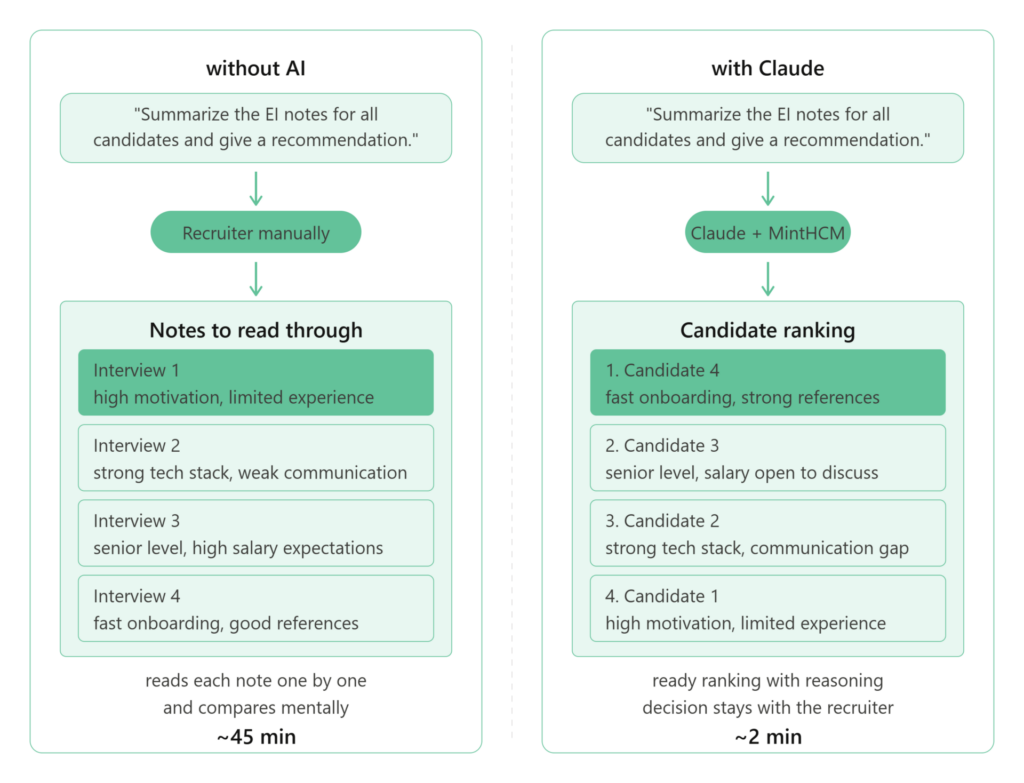
This is one of the most valuable applications. After a series of initial interviews, the recruiter has dozens of notes entered into the entry interview field across candidature records. Normally: reading them one by one, comparing mentally, writing up a summary. With Claude: “Summarize the EI notes for all PHP Developer candidates and tell me who you’d recommend advancing” – Claude reads all notes directly from MintHCM, compares them, and returns a ranked list with reasoning. The decision belongs to the recruiter; the analytical groundwork is done.
Scheduling and calendar management
- “Check Anna Nowak’s availability on Wednesday between 10 and 14” – the
Check availabilitytool queries the calendar and returns the information. - “What’s on my calendar today?” – the
Calendartool returns the day’s events without opening the system. - Claude can also immediately create a meeting with the relevant participants if the recruiter issues the instruction in a single sentence.
Pulling recruitment data together
MintHCM allows users to create and save custom reports in its reporting module. If such a report already exists in the system, Claude can run it directly through the Execute report tool and return the results without opening the interface. Beyond saved reports, Claude can also query data on its own: “How many candidatures came in this month and from which sources?” – it queries Candidatures filtered by date, counts records, and groups by the source field. “How many active recruitments do we have and for which positions?” – one sentence, answer in seconds.
Salary range verification
MintHCM stores salary ranges per position – gross, net, and employer cost, each with a from/to range. Candidatures have a salary expectation field. Claude can cross-reference the two without opening the system: “Of the PHP Developer candidates, how many fall within the salary range?” – the answer comes in seconds, broken down by those who fit, those who exceed it, and those who didn’t provide expectations. No manual comparison record by record.
Candidate communication
MintHCM stores email templates with placeholders for candidate data. Claude, knowing the current candidature status and candidate details from the system, can suggest ready-to-use message content matched to the stage – an Entry Interview invitation, an interview confirmation, or a post-recruitment rejection notice. The recruiter reviews and sends. No writing each email from scratch.
Redirecting to another recruitment
A candidate doesn’t fit one recruitment, but their profile matches another. MintHCM supports moving a candidature between recruitments – the current candidature status changes to Rejected automatically, and a new candidature opens in the target recruitment. Claude can review currently open recruitments in the system and proactively suggest: “This candidate doesn’t meet the Senior PHP requirements, but there’s an open Mid PHP recruitment – shall I move them?” With thirty open recruitments running simultaneously, that’s a connection a recruiter could simply miss.
Onboarding immediately after hire
When a candidature receives the status Hired, Claude can immediately create an onboarding record for the new employee based on the template assigned to the position – onboarding elements are generated automatically. The transition from recruitment to onboarding happens without a gap and without relying on anyone to remember a separate manual step.
Job advertisements
MintHCM stores positions (Positions), responsibilities (Responsibilities), and salary ranges. Claude can generate ready-to-use job ad copy based on that data – without retyping anything from the system into a text editor. The data is in Mint; Claude reads it and turns it into text.
Why This Works Differently from Conventional AI Tools
Most AI tools for HR operate on data you manually paste into an interface. Claude through MCP operates on data already in the system – current, complete, and in the context of the entire process.
This has several practical consequences:
- No retyping. There’s no need to export a candidate list to CSV for AI to analyze. Claude connects to MintHCM directly.
- Conversational context. Claude remembers what was said earlier in the same session – “now do the same for the second candidate” works without repeating the full instruction.
- Multi-step workflows in one sentence. Individual MCP tools handle individual operations. Claude chains them into sequences – “check availability, create a meeting, update the candidature status” is one prompt, not three separate clicks.
- Model freedom. MintHCM works with Claude (Anthropic), ChatGPT (OpenAI), Gemini (Google), and others. Organizations choose the model that best fits their needs and data security policies. There is no vendor lock-in on the AI side.
What This Means for Staffing Agencies and HR Teams
For staffing agencies managing fifteen or thirty active recruitments simultaneously, the effect is particularly pronounced. The data is in MintHCM – candidates, candidatures, statuses, notes. The problem was never the absence of data; it was the time needed to reach it and act on it. MCP collapses that time significantly.
This is not about replacing the recruiter. It’s about ensuring recruiters don’t spend hours clicking when they could be talking to candidates, building relationships, and making decisions. Administration is for AI. Judgment is for people.
Summary
MintHCM has been collecting recruitment process data for years. MCP makes that data accessible in a way that previously required a separate report or an hour at the dashboard. Claude understands natural-language instructions, maps them to MCP tools, and executes actions directly inside the system. The result: less clicking, less retyping, more time for what AI cannot replace.
Frequently Asked Questions
What recruitment tasks can Claude handle when connected to MintHCM via MCP?
When Claude is connected to MintHCM through the Model Context Protocol, it can search candidate records across multiple modules simultaneously, create and update candidatures, pull salary data for a given role, analyse Entry Interview notes and produce a ranked comparison of candidates, check a recruiter’s calendar and schedule meetings, update candidature statuses, and generate recruitment summaries – all through natural language instructions, without the recruiter logging into MintHCM directly.
What is MCP and why does it matter for HR systems?
MCP (Model Context Protocol) is an open standard that defines how AI models communicate with external applications, tools, and data sources. For HR systems, it means an AI assistant like Claude can act directly inside MintHCM – not just answer general questions, but query live data, create records, and take actions within the system. MintHCM is among the first HCM platforms to have MCP built natively into the product, rather than as a third-party wrapper around an API.
How much time can recruiters save using Claude with MintHCM?
According to the Ashby Talent Trends Report (2024), 45% of talent acquisition leaders spend more than half their working time on administrative tasks. Industry estimates suggest recruiters lose up to 14 hours per week on work that AI could handle: data entry, status updates, interview scheduling, and pulling data across modules. The exact time savings depend on recruitment volume and workflow complexity, but the impact is visible across the entire funnel – from candidature intake through onboarding launch.
Does Claude store or have access to MintHCM data outside of a session?
No. Claude accesses MintHCM data only during an active session through the MCP connection. Data is retrieved in real time from MintHCM’s own database – it is not stored by Claude or Anthropic. The MCP architecture uses OAuth 2.1 authentication and operates within the security boundaries configured by the MintHCM administrator, meaning Claude can only access modules and data that the authenticated user is permitted to see.
Is the Claude–MintHCM integration available to all MintHCM users?
Yes. Mint MCP is a native module in MintHCM, available from version 4.2.0 onwards. Setting it up requires configuring a dedicated domain pointing to the MCP directory of the MintHCM instance and enabling OAuth 2.1 authentication. The integration works with Claude.ai and other MCP-compatible clients. Full setup instructions are available at minthcm.org/mint-mcp-instructions/.
What happens to the AI analysis if the recruiter’s notes are low quality?
The quality of Claude’s output is directly dependent on the quality of input data. Thin, inconsistent, or vague Entry Interview notes produce unreliable rankings and summaries. This is not a limitation of the AI – it is a data governance issue. The practical implication is that recruiters need to write substantive, structured notes for the AI analysis to be actionable. MintHCM’s Entry Interview module provides a structured format to guide note-taking, which improves both human readability and AI output quality.